Przejdź do treści głównej

Autor: AEA - EAL

Webinar on Mediation – info and free registration

How to join?

Registration is closed!

Where?

On Zoom Platform accessible for all registered people.

When?

On January 28, 2021 (Thursday) at:

08.30 – Buenos Aires
12.30 – Brussels
15.30 – Tbilisi
16.30 – Tashkent
17.30 – Almaty
19:30 – Hong Kong

How much should I pay?

Webinar is free of charge for all registered persons.


Program and agenda:

Duration: 90 minutes
1. Opening Remarks
2. Lawyers & Mediators about Mediation
3. Q&A Session
4. Singapore Convention – discussion panel
5. Summary and closing remarks


1. Opening remarks

  • Maria Ślązak, President of the European Association of Lawyers (AEA-EAL)
  • David Asatiani, President of the Georgian Bar Association
  • Melissa Pang, President of the Law Society of Hong Kong


2. Lawyers & Mediators about Mediation

First part of the seminar addresses two main issues:

  • Court-annexed and private mediation – experience from various jurisdictions
  • Lawyers as representatives in mediation and lawyers as mediatiors

Introductory remarks:

Irakli Kandashvili LL.M, moderator of the seminar, Chairman of the Mediators Association in Georgia.Managing Partner of the K&K Consulting, Doctor of law from State University in Tbilisi, practicing lawyer, member of the Executive Board of the Georgian Bar Association (GBA), Chairman of the Educational Council of the GBA


Speakers:

Carmen Pérez Andújar, ITER Law & Partners (Madrid – Sevilla); Partner responsible for the Department of Litigation and Arbitration. Lawyer and mediator with 25 years of experience in litigation, mediation and arbitration.

Marcelo Castrogiovanni, lawyer, member of the AEA-EAL, Professor at the Faculty of Law, University of Buenos Aires, Director of the Electronic Magazine of Commercial Law, Founding member of the Foundation for Advanced Studies in Legal Sciences

Sabine Perquy-Forke, responsible for German desk in Van Landuyt & Partners, lawyer in Brussels, member of the AEA-EAL Board of Directors, member of German, Belgium and French Bars, specialised in civil and commercial cases

Sevara Maripova, lawyer and mediator, Associated Professor at the University in Tashkent, Head of the Department of Private Law of the Center for Continuing Legal Education, expert in training of mediators, author of training courses and materials

Melissa Pang, lawyer and mediator, Pang & Associates Law Firm, Hong Kong, specialist in commercial law, property law as well as civil litigation and mediation, notary public, solicitor in South Wales, Australia. President of the Law Society of Hong Kong

Sergei Vataev, lawyer and mediator, independent contractor for Dechert. He focuses on litigation, mediation and arbitration, corporate law, and project finance. Chairman of the International Arbitration Court of the Republic of Kazakhstan


3. Q&A Session


4. Singapore Convention

The discussion panel is devoted to the United Nations Convention on International Settlement Agreements resulting from Mediation, also known as the “Singapore Convention on Mediation

  • Introductory remarks by Professor Irakli Kandashvili
  • Discussion panel of experts

5. Summary and closing remarks

  • Professor Irakli Kandashvili
  • President Maria Ślązak

Christmas wishes from AEA-EAL President


Dear Friends,

Year 2020 is about to end. Twelve months different than any other ones, faced by our generation, marked with the Covid-19 pandemic and affecting our professional and private life in all aspects. The activity of the AEA-EAL has changed with moving our events and other actions into virtual reality. For the first time our General Assembly was organized in hybrid form, and participants of the 2nd Twinning of Lawyers  met online. All our conferences and events moved to virtual space, which gave us new opportunities but also limited personal contacts and mutual interactions between colleagues from various countries and continents.

Let us look over this time. We conducted many of webinars and online meetings. I will  mention only some of them. . After very successful networking event – first Twinning of Lawyers from East and West held in Gdańsk (Poland) in 2019, we held  in September of this year the second Twinning, but due to  pandemic – in a form of virtual reunion. Representatives of more than 15 countries from Asia, South America and Europe gathered together again to exchange experience and to maintain friendly relations. The other initiative – for the first time we made an event in Spanish language for our colleagues from Argentina, Brazil, Ecuador, Mexico and Uruguay. Every year we are invited to participate the European President’s Conference in Vienna and yearly lawyers’ San Ramon de Penyacort festivity in Barcelona. This year we were requested by the Council of Europe to give the expertise in the framework of drafting the European Convention on the profession of a lawyer.  As member of Defense of Defenders network we support our colleagues persecuted for their professional activity. We also updated our communication channels – new layout of the website and Newsletter with the aim of making them in more communicative form. I do hope you will enjoy those changes.

Taking this opportunity, I wish to invite all of you for our first event in forthcoming year – workshop on mediation, which is taking place on  January 28, 2021. More information will be available soon on our website.

So as the calendar page turns to the  New Year, let me  thank  for your continued dedication and support for our actions. The AEA-EAL may be strong only because of your engagement  – our members and friends as speakers, co-organizers and back-stage supporters of all many  activities of the Association. I do hope that in 2021 we will do even more together as members of international legal community. It is a great honour for me to lead the AEA-EAL and I am looking forward to a successful year 2021 with common efforts to promote networking, continuing legal training and fostering independent profession for the good of our clients and societies.

Merry Christmas and a Happy New Year!

Maria Ślązak

3rd Market Access Seminar


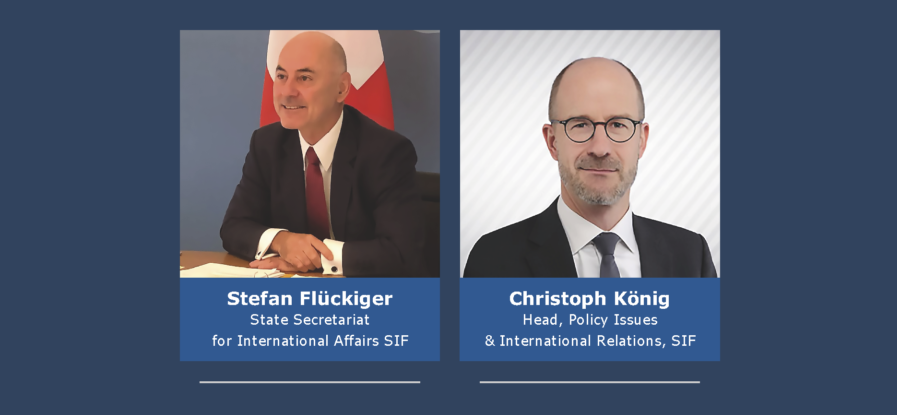
On 11 December 2020 the AEA-EAL, together with the World Trade Institute in Berne and the Swiss law firm Prager Dreifuss Ltd, as a co-organiser, conducted a webinar about Financial Services in Europe in the Global Context Bridges and Ditches for Switzerland. The AEA-EAL and two co-organisers have, in the last two years, successfully launched annual conferences on market access. As this year, for well known reasons, such a conference could not be held, they organized a virtual conference. At this conference, which attracted an important number of people, we hosted Stefan Flückiger, Deputy State Secretary and Christoph König, Head Policy Issues & International Relations of the Swiss State Secretariat for international Finance (SIF). Their presentations gave an excellent overview on Switzerland as an important financial center and its possible ways on how to build „bridges” towards the EU and the UK. The two speakers also explained the global context of the financial services area and informed about future markets and sector growth and where future wealth and clients will be situated. They concluded that European markets will remain important, demographic growth in Asia be marginal and that the US will still matter for wealth and asset management. For Switzerland bilateral financial dialogues as well as multilateral relations, in particular the G20/OECD, will therefore also in the future be important tools to be present in the international financial services world.

Compliance in Covid’s time

December 17, 2020

Mélanie Diaz

Without a doubt, the experience of a pandemic such as the coronavirus has disrupted our society at all levels, testing us all, generating as many crises as opportunities; although it is proving difficult to see the light at the end of the tunnel, we must not lose sight of the opportunities that this unexpected situation also offers us.

The „new normality” we are currently experiencing has highlighted the urgent need to clearly identify the Compliance risks to which an organization may be exposed and the appropriate management of these risks, even for scenarios as unpredictable as a pandemic, to which it is very important to consider specific contingency plans.

Ethical culture

Companies must understand the need to establish an internal culture of Compliance and a commitment to ethics that permeates their actions, thus making of good practices the norm within the company and in its relations with third parties. If this is still a pending task, it is a good time to review internally the implementation of these issues in the organization.

Any new business movement, a sale, an absorption, a merger or a spin-off, and any business transformation, will be clouded by the lack of a good documentary, procedural, fiscal or ethical order, with the corresponding protocols to support them, since it should not be forgotten that article 130.2 of the Spanish Criminal Code establishes that criminal liability is transmitted and not extinguished, as happens with the death of individuals. A similar situation is to be found in other countries.

Market requirements

It is important to have 'the house in order’ and, increasingly, a good Compliance incorporated, if we want to sell to certain customers who, more and more, incorporate ethical rules that prevent buying from companies that do not have incorporated such instruments of internal control and traceability, to ensure a good regulatory and ethical.

It is an indisputable fact that, if we want to be accepted as provider of companies of a certain size, we have to implement these procedures, so that, if a company aspires to wider and higher horizons, one day or another it is going to face this inconvenience.

Anticipating this in advance will facilitate this moment and access to better business partners will be much easier. We should not leave it 'for later’. We are seeing with this pandemic how difficult it is for us to foresee, our tendency to 'nothing will happen’; and the consequences of this are being experienced these days. Let us try, in our business, to be one step ahead of the events.

ECJ judgment in Case C-667/19 A.M. v E.M., December 17, 2020

Information as to the ‘function’ of a cosmetic product which must appear on the product’s container and its packaging must inform consumers clearly as to that product’s purpose and method of use.

Information concerning the particular precautions to be observed when using that product, its function and its ingredients may not appear in a company catalogue referred to by the symbol of a hand with an open book placed on the packaging or the container.

In 2016 A.M., who, inter alia, owns a beauty salon in Poland, purchased creams, facial masks and powders from a manufacturer based in the United States via E.M., distributor of those products. The packaging of those products bore the name of the responsible entity, the original name of the cosmetic product, its composition, expiry date and serial number as well as the following symbol, representing a hand with an open book, referring to a catalogue containing all the information in Polish.

A.M. terminated the contract for the sale of those products, claiming that there was no Polish language information on the packaging regarding the product’s function, which made it impossible to identify what the product was and what its effects were, and that that information was not clear from the presentation. She also claimed that the information in Polish, required under Polish law and arising from EU law, appeared only in the catalogue, which is not enclosed with or attached to the product.

Since her action seeking reimbursement of the costs of purchasing those products was dismissed, A.M. brought an appeal before the Sąd Okręgowy w Warszawie XXIII Wydział Gospodarczy Odwoławczy (Regional Court, Warsaw, Commercial Appeals Division No 23, Poland). That court asked the Court of Justice to interpret the EU regulation on cosmetic products (1).

By today’s judgment, the Court recalls, first of all, that that regulation seeks to harmonise comprehensively the rules in the European Union in order to achieve an internal market for cosmetic products while ensuring a high level of protection of human health.

It points out in that regard that there is a close connection between, on the one hand, the safety of cosmetic products placed on the market and, on the other hand, the requirements concerning how they are presented and labelled. It follows that the requirement to provide information in indelible, easily legible and visible lettering on the container and on the packaging of cosmetic products concerning the function of the cosmetic product (2) cannot be confined to a requirement to provide information on the purposes of the product’s use, namely to clean, to perfume, to change the appearance, to protect or to keep a part of the body in good condition or to correct body odours. Whilst those purposes make it possible to assess whether a particular product, depending on its use and its purpose, may be categorised as a cosmetic product and therefore, may be distinguished from other products falling outside the scope of the regulation, the ‘function of the cosmetic product’ concerns information relating to characteristics more specific to the product.

The Court concludes that the information as to the ‘function of a cosmetic product’ which must appear on such a product’s container and packaging must be such as to inform consumers clearly as to the product’s purpose and method of use, in order to ensure that consumers can use that product safely, without negatively affecting their health. It is for the national courts, in the light of the characteristics and properties of the product concerned as well as the expectations of the average consumer, who is reasonably well informed and reasonably observant and circumspect, to review the nature and extent of the information which must appear in that regard on the product’s packaging and container so that it can be used without risk to human health.

Next, the Court considers whether the information concerning particular precautions for use of a cosmetic product, its function and its ingredients may appear in a company catalogue which also includes other products, where the symbol of a hand with an open book is placed on the cosmetic product’s packaging or container.

It finds that, when a reference must be provided, only an ‘enclosed or attached leaflet, label, tape, tag or card’ may be used as supporting documentation for the cosmetic product. A company catalogue which is provided separately and contains a description of one or more cosmetic products at issue, but also describes other products from the manufacturer’s range, is not enclosed or attached to a specific product. In addition, supporting documentation may be used only where it is impossible ‘for practical reasons’ to place that information on the label. Such impossibility refers to situations where it is impossible in practice, on account of the nature and the actual presentation of the product, to place certain information on the label.

In that regard, the fact that the cosmetic products concerned have been imported – which, in view of the requirement to place on the label the required information in the language determined by the law of the Member States in which the product is made available to end users, may give rise to organisational and financial issues stemming from the need to translate certain information and to relabel or even repackage the products – does not in itself establish that it is impossible in practice to place that information on the label. The cost of labelling those products in a different language in order to market them in other Member States cannot in any case be regarded as justifying incomplete labelling of the product on its container and its packaging. The Court finds that such a requirement ensures a high level of protection for consumers. Protection of health cannot in fact be fully guaranteed if consumers are not in a position to familiarise themselves fully with, and to understand, in particular, the information concerning the function of the cosmetic product concerned and the particular precautions to be observed when using it. The Court finds that the information which producers or distributors of cosmetics products covered by the regulation must mention on the product container and packaging, save where that information can be effectively conveyed by the use of pictogrammes or signs other than words, will be of no practical use unless it is given in a language which can be understood by the persons for whom it is intended.

Similarly, the fact that cosmetic product labelling is the responsibility of the manufacturer of those products, not their distributor, does not establish either that it is impossible for practical reasons to place the required information on the label of those products. In that regard, the Court points out that the intention on the part of the manufacturer or distributor of such products to facilitate their movement within the European Union is not in itself sufficient to justify reference to only some of the required information. Since ‘impossibility’ refers generally to a factual circumstance over which the person invoking it has no control, it cannot entitle a manufacturer or distributor of cosmetic products, because of the number of EU or other languages which it decides to use, to claim, for its own convenience, that full compliance is ‘impossible for practical reasons’ within the meaning of the regulation.

It follows that information concerning the particular precautions to be observed when using the cosmetic product, the product’s function and its ingredients may not appear in a company catalogue referred to by the symbol of a hand with an open book placed on the product’s packaging or container.

Footnotes:

(1) Regulation (EC) No 1223/2009 of the European Parliament and of the Council of 30 November 2009 on cosmetic products (OJ 2009 L 342, p. 59).

(2) Laid down in Article 19(1)(f) of the regulation.


NOTE: A reference for a preliminary ruling allows the courts and tribunals of the Member States, in disputes which have been brought before them, to refer questions to the Court of Justice about the interpretation of European Union law or the validity of a European Union act. The Court of Justice does not decide the dispute itself. It is for the national court or tribunal to dispose of the case in accordance with the Court’s decision, which is similarly binding on other national courts or tribunals before which a similar issue is raised.


Unofficial document for media use, not binding on the Court of Justice. The full text of the judgment is published on the CURIA website on the day of delivery.

Source: www.curia.eu

ECJ judgment in Joined Cases C-354/20 PPU and C-412/20 PPU Openbaar Ministerie (Independence of the issuing judicial authority), December 17, 2020

The existence of evidence of systemic or generalised deficiencies concerning judicial independence in Poland or of an increase in those deficiencies does not in itself justify the judicial authorities of the other Member States refusing to execute any European arrest warrant issued by a Polish judicial authority.

However, the execution of a European arrest warrant issued by a Polish judicial authority must be refused if, having regard to the individual situation of the person concerned, the nature of the offence in question and the factual context in which that European arrest warrant has been issued, there are substantial grounds for believing that, on account of those deficiencies, that person will run a real risk of breach of his or her right to a fair trial once he or she is surrendered to those authorities.

In August 2015 and February 2019, European arrest warrants (‘EAWs’) were issued by Polish courts against two Polish nationals for the purposes of conducting a criminal prosecution and executing a custodial sentence. Since the persons concerned are in the Netherlands, the officier van justitie (representative of the public prosecution service, Netherlands) referred the requests for execution of those EAWs to the rechtbank Amsterdam (District Court, Amsterdam, Netherlands).

However, that court has doubts as to whether it should accede to those requests. More specifically, it raises the question of the implications of the judgment in Minister for Justice and Equality (Deficiencies in the system of justice) (1), which was delivered against the backdrop of the reforms of the Polish judicial system. In that judgment, the Court held that, by way of exception, the execution of an EAW may be refused if it is established that the person concerned might, if he or she is surrendered to the Member State which issued the EAW, sustain a breach of his or her right to an independent tribunal, which is an essential component of the right to a fair trial (2). Nevertheless, such a refusal is possible only following a two-step examination: having assessed in a general manner whether there is objective evidence of a risk of breach of that right, on account of systemic or generalised deficiencies concerning the independence of the issuing Member State’s judiciary, the executing judicial authority must then determine to what extent such deficiencies are liable to have an actual impact on the situation of the person concerned if he or she is surrendered to the judicial authorities of that Member State.

On account of recent developments (3), some of which have occurred after the EAW in question was issued, the rechtbank Amsterdam considers that the deficiencies in the Polish system of justice are such that the independence of all Polish courts and, consequently, the right of all individuals in Poland to an independent tribunal are no longer ensured. In that context, the rechtbank is uncertain whether that finding is sufficient in itself to justify a refusal to execute an EAW issued by a Polish court, without there being any need to examine the impact of those deficiencies in the particular circumstances of the case.

In the context of the urgent preliminary ruling procedure (PPU), the Court, sitting as the Grand Chamber, answers that point in the negative, thus confirming its case-law established in the judgment in Minister for Justice and Equality (Deficiencies in the legal system).

The Court’s findings

In the first place, the Court holds that systemic or generalised deficiencies affecting the independence of the issuing Member State’s judiciary, however serious, are not sufficient on their own to enable an executing judicial authority to consider that all the courts of that Member State fail to fall within the concept of an ‘issuing judicial authority’ of an EAW (4), a concept which implies, in principle, that the authority concerned acts independently.

In that regard, first, the Court observes that such deficiencies do not necessarily affect every decision that those courts may be led to adopt. The Court goes on to state that, although limitations may in exceptional circumstances be placed on the principles of mutual trust and mutual recognition which underpin the operation of the EAW mechanism, denial of the status of ‘issuing judicial authority’ to all the courts of the Member State concerned by those deficiencies would lead to a general exclusion of the application of those principles in connection with the EAWs issued by those courts. Moreover, such an approach would have other very significant consequences since it would imply, inter alia, that the courts of that Member State would no longer be able to submit references to the Court for preliminary rulings (5). Lastly, the Court states that its recent case-law according to which the public prosecutors’ offices of certain Member States fail, in the light of their subordinate relationship to the executive, to provide sufficient guarantees of independence to be regarded as ‘issuing judicial authorities’ (6) cannot be transposed to Member States’ courts. In a Union based on the rule of law, the requirement that courts be independent precludes by its very nature any relationship of that type with the executive.

In the second place, the Court states that the existence of or an increase in systemic or generalised deficiencies concerning the independence of the issuing Member State’s judiciary, which are indicative of a risk of breach of the right to a fair trial, does not however permit the presumption (7) that the person in respect of whom an EAW has been issued will actually run such a risk if he or she is surrendered. Thus, the Court maintains the requirement of a two-step examination set out in the judgment in Minister for Justice and Equality (Deficiencies in the legal system) and states that the finding of such deficiencies must indeed prompt the executing judicial authority to exercise vigilance but cannot dispense it from conducting, in accordance with the second step of that examination, a specific and precise assessment of the risk in question. That assessment must take account of the situation of the requested person, the nature of the offence in question and the factual context which forms the basis of the EAW, such as statements by public authorities which are liable to interfere with the way in which the individual case is handled. The Court points out in that regard that a general suspension of the EAW mechanism with regard to a Member State, which would make it permissible to refrain from carrying out such an assessment and to automatically refuse to execute EAWs issued by that Member State, is possible only if the European Council formally declares that the Member State has failed to respect the principles on which the Union is based (8).

Furthermore, the Court specifies that, where the EAW has been issued for the purposes of criminal proceedings, the executing judicial authority must, where appropriate, take account of systemic or generalised deficiencies concerning the independence of the issuing Member State’s judiciary which may have arisen after the EAW concerned was issued and assess to what extent those deficiencies are liable to have an impact at the level of that Member State’s courts with jurisdiction over the proceedings to which the person concerned will be subject. Where an EAW is issued with a view to the surrender of a requested person for the execution of a custodial sentence or a detention order, the executing judicial authority must examine to what extent the systemic or generalised deficiencies which existed in the issuing Member State at the time of issue of the European arrest warrant have, in the particular circumstances of the case, affected the independence of the court of that Member State which imposed the custodial sentence or detention order the execution of which is the subject of that EAW.

Footnotes:

(1) Judgment of 25 July 2018, Minister for Justice and Equality (Deficiencies in the system of justice), C-216/18 PPU; see also Press Release No 113/18.

(2) That right is guaranteed in the second paragraph of Article 47 of the Charter of Fundamental Rights of the European Union.

(3) Alongside other factors, the referring court mentions in particular the Court’s recent case-law in this area (judgments of 19 November 2019, A.K. (Independence of the Disciplinary Chamber of the Supreme Court), Joined Cases C-585/18, C-624/18 and C-625/18; see also Press Release No 145/19, and of 26 March 2020, Miasto Łowicz and Prokurator Generalny (Disciplinary regime concerning judges), Joined Cases C-558/18 and C-563/18; see also Press Release No 35/20, and the action for failure to fulfil obligations brought by the Commission against Poland (pending case C-791/19).

(4) Within the meaning of Article 6(1) of Council Framework Decision of 13 June 2002 on the European arrest warrant and the surrender procedures between Member States – Statements made by certain Member States on the adoption of the Framework Decision (OJ 2002 L 190, p. 1), as amended by Council Framework Decision 2009/299/JHA of 26 February 2009 (OJ 2009 L 81, p. 24).

(5) That approach would mean that no court of the issuing Member State would any longer be considered to satisfy the requirement of independence inherent in the concept of ‘court or tribunal’ within the meaning of Article 267 TFEU.

(6) See, in particular, the judgment of 27 May 2019, OG and PI (Public Prosecutor’s Offices in Lübeck and Zwickau), Joined Cases C-508/18 and C-82/19 PPU; see also Press Release No 68/19.

(7) Under Article 1(3) of the Framework Decision on the EAW.

(8) That procedure is provided for in Article 7(2) TEU.


NOTE: A reference for a preliminary ruling allows the courts and tribunals of the Member States, in disputes which have been brought before them, to refer questions to the Court of Justice about the interpretation of European Union law or the validity of a European Union act. The Court of Justice does not decide the dispute itself. It is for the national court or tribunal to dispose of the case in accordance with the Court’s decision, which is similarly binding on other national courts or tribunals before which a similar issue is raised.


Unofficial document for media use, not binding on the Court of Justice. The full text of the judgment is published on the CURIA website on the day of delivery.

Source: www.curia.eu

CJE judgment in Case C-336/19 Centraal Israëlitisch Consistorie van België and Others, December 17, 2020

In order to promote animal welfare in the context of ritual slaughter, Member States may, without infringing the fundamental rights enshrined in the Charter, require a reversible stunning procedure which cannot result in the animal’s death.

A decree of the Flemish Region (Belgium) of 7 July 2017 (‘the decree’), amending the Law on the protection and welfare of animals, regarding permitted methods of slaughtering animals, prohibits animals from being slaughtered without prior stunning, including in the case of slaughter prescribed by a religious rite. In the context of ritual slaughter, the decree provides for the use of reversible stunning which cannot result in the animal’s death.

The decree was challenged, inter alia, by several Jewish and Muslim associations, seeking its annulment in whole or in part. In their view, in not allowing Jewish and Muslim believers to obtain meat from animals slaughtered in accordance with their religious precepts, which preclude the reversible stunning technique, the decree infringes Regulation No 1099/2009 (1) and, therefore, prevents believers from practising their religion.

It is in that context that the Grondwettelijk Hof (Constitutional Court, Belgium) decided to make a reference to the Court of Justice for a preliminary ruling in order to ascertain, principally, whether EU law precludes legislation of a Member State which requires, in the context of ritual slaughter, a reversible stunning procedure which cannot result in the animal’s death.

This question leads the Court, for the third time (2), to seek a balance between freedom of religion, guaranteed by Article 10 of the Charter of Fundamental Rights of the European Union (‘the Charter’), and animal welfare, as set out in Article 13 TFEU and given specific expression to in Regulation No 1099/2009.

Findings of the Court

The Court, sitting as the Grand Chamber, observes, first of all, that the principle that an animal should be stunned prior to being killed, laid down by Regulation No 1099/2009, meets the main objective of the protection of animal welfare pursued by that regulation. In that regard, although the regulation (3) permits the practice of ritual slaughter in accordance with which an animal may be killed without first being stunned, that form of slaughter is, however, authorised only by way of derogation in the European Union and solely in order to ensure observance of freedom of religion. In addition, Member States may adopt national rules aimed at ensuring more extensive protection of animals at the time of killing than those contained in Regulation No 1099/2009 in relation to ritual slaughter (4). Thus, Regulation No 1099/2009 reflects the fact that the European Union and the Member States are to pay full regard to the welfare requirements of animals, while respecting the provisions and customs of the Member States relating in particular to religious rites. However, Regulation No 1099/2009 does not itself effect the necessary reconciliation between animal welfare and the freedom to manifest religion, but merely provides a framework for the reconciliation which Member States must achieve between those two values.

It follows that Regulation No 1099/2009 does not preclude Member States from imposing an obligation to stun animals prior to killing which also applies in the case of slaughter prescribed by religious rites, provided, however, that, in so doing, the Member States respect the fundamental rights enshrined in the Charter.

As regards, specifically, the question whether the decree respects those fundamental rights, the Court points out that ritual slaughter falls within the scope of the freedom to manifest religion, guaranteed in Article 10(1) of the Charter. By requiring, in the context of ritual slaughter, reversible stunning, contrary to the religious precepts of Jewish and Muslim believers, the decree thus entails a limitation on the exercise of the right of those believers to the freedom to manifest their religion.

In order to assess whether such a limitation is permissible, the Court finds, first of all, that the interference with the freedom to manifest religion resulting from the decree is indeed provided for by law and, moreover, respects the essence of Article 10 of the Charter, since it is limited to one aspect of the specific ritual act of slaughter, and that act of slaughter is not, by contrast, prohibited as such.

The Court then finds that that interference meets an objective of general interest recognised by the European Union, namely the promotion of animal welfare.

In its examination of the proportionality of the limitation, the Court concludes that the measures contained in the decree allow a fair balance to be struck between the importance attached to animal welfare and the freedom of Jewish and Muslim believers to manifest their religion. In that regard, it states, first, that the obligation to use reversible stunning is appropriate for achieving the objective of promoting animal welfare. Secondly, as regards the necessity of the interference, the Court emphasises that the EU legislature intended to give each Member State a broad discretion in the context of the need to reconcile the protection of the welfare of animals when they are killed and respect for the freedom to manifest religion. As it is, a scientific consensus has emerged that prior stunning is the optimal means of reducing the animal’s suffering at the time of killing. Thirdly, as regards the proportionality of that interference, the Court observes, first of all, that the Flemish legislature relied on scientific research and that it sought to give preference to the most up-to-date method of killing that is authorised. It points out, next, that that legislature forms part of an evolving societal and legislative context, which is characterised by an increasing awareness of the issue of animal welfare. Lastly, the Court finds that the decree neither prohibits nor hinders the putting into circulation of products of animal origin derived from animals which have undergone ritual slaughter, where those products originate in another Member State or in a non-Member State.

Accordingly, the Court holds that Regulation No 1099/2009, read in the light of Article 13 TFEU and Article 10(1) of the Charter, does not preclude legislation of a Member State which requires, in the context of ritual slaughter, a reversible stunning procedure which cannot result in the animal’s death.

In addition, the Court upholds the validity of Regulation No 1099/2009 (5) in the light of the principles of equality, non-discrimination and cultural, religious and linguistic diversity, as guaranteed by the Charter (6). The fact that Regulation No 1099/2009 authorises Member States to take measures such as compulsory stunning in the context of ritual slaughter, but contains no similar provision governing the killing of animals in the context of hunting and recreational fishing activities or during cultural or sporting events, is not contrary to those principles.

In that regard, the Court points out that cultural and sporting events result at most in a marginal production of meat which is not economically significant. Consequently, such events cannot reasonably be understood as a food production activity, which justifies their being treated differently from slaughtering. The Court draws the same conclusion with regard to hunting and recreational fishing activities. Those activities take place in a context where conditions for killing are very different from those employed for farmed animals.

Footnotes:

(1) Council Regulation (EC) No 1099/2009 of 24 September 2009 on the protection of animals at the time of killing (OJ 2009 L 303, p. 1).

(2) After the judgments of 29 May 2018, Liga van Moskeeën en Islamitische Organisaties Provincie Antwerpen and Others, C-426/16 (see Press Release No 69/18), and of 26 February 2019, Œuvre d’assistance aux bêtes d’abattoirs, C-497/17 (see Press release No 15/2019).

(3) Article 4(4) of Regulation No 1099/2009.

(4) Point (c) of the first subparagraph of Article 26(2) of Regulation No 1099/2009.

(5) In particular, point (c) of the first subparagraph of Article 26(2), concerning the power of Member States to adopt national rules aimed at ensuring more extensive protection of animals in the case of ritual slaughter.

(6) Articles 20, 21 and 22 of the Charter, respectively.


NOTE: A reference for a preliminary ruling allows the courts and tribunals of the Member States, in disputes which have been brought before them, to refer questions to the Court of Justice about the interpretation of European Union law or the validity of a European Union act. The Court of Justice does not decide the dispute itself. It is for the national court or tribunal to dispose of the case in accordance with the Court’s decision, which is similarly binding on other national courts or tribunals before which a similar issue is raised.


Unofficial document for media use, not binding on the Court of Justice. The full text of the judgment is published on the CURIA website on the day of delivery.

Source: www.curia.eu

ECHR judgment in the case of Béla Németh v. Hungary (application no. 73303/14), December 17, 2020

State moratorium on evictions lawful in property acquirer’s case

In today’s Chamber judgment1 in the case of Béla Németh v. Hungary (application no. 73303/14) the European Court of Human Rights held, unanimously, that there had been:

no violation Article 1 of Protocol No. 1 (protection of property) and Article 14 (prohibition of discrimination) to the European Convention on Human Rights.

The case concerned the applicant’s not being able to take possession of a property he had bought owing to a legal moratorium on evictions. State bodies had been exempt from the moratorium. He had had to wait two years before ultimately being able to exercise his ownership rights.

The Court found that the moratorium had had a basis in law, had served a legitimate interest, and, in particular, had not deprived him of his legitimate expectation regarding ownership of the property, merely delayed it.

The Court also found that the applicant’s situation had not been comparable to that of State actors and as such he had suffered no discrimination.


Principal facts

The applicant, Béla Miklós Németh, is a Hungarian national who was born in 1948 and lives in Kistarcsa (Hungary).

In 2014 the applicant bought a property at auction. It was being sold in judicial enforcement proceedings which had arisen from a debt.

A legal amendment to the Enforcement Act was introduced, placing a moratorium on evictions caused by the recovery of debts in an effort to mitigate the effects of the 2008 financial crisis. The moratorium did not apply to agents of the State. It initially had no set end date.

The applicant had not yet been given title to the property and the debtor could now not be evicted. The applicant submits that he was able to get title to and possession of the property only two years after he had purchased it.

Complaints

Relying on Articles 1 of Protocol No. 1 (protection of property) and 14 (prohibition of discrimination), the applicant complained that he had been denied use of his property and that he had been discriminated against in that the relevant legislation had protected State-owned actors to the detriment of the private sector.

The application was lodged with the European Court of Human Rights on 14 November 2014.

Decision of the Court

Article 1 of Protocol No. 1

The Government argued that the applicant had had an expectation that he would acquire the assetwhen he had bought the property. However that had been insufficient to engage his Convention rights, as he had not as yet been the owner. The Government also highlighted the societal need for the measures the State had taken. The applicant, however, stated that the property had been part of his portfolio of assets.

The Court considered that the applicant had at least a legitimate expectation of ownership under Hungarian law, constituting a possession for the purposes of the Convention. The application was admissible.

The Court reiterated that interferences with private property had to be lawful, had to pursue a legitimate aim in the public interest, and had to strike a balance between the general interest and the individual’s rights.

The parties did not dispute that the applicant had had his use of his property “controlled” by the State. The Court agreed.

The Court noted that the moratorium had had a basis in law. Questions around uncertainty in the relevant law were questions of fair balance, in the Court’s opinion.

The Court adjudged that the actions of the national legislature in enacting the moratorium had fallen within its discretion and had not been “manifestly without reasonable foundation”. The moratorium had met the public-interest requirements of the Convention.

The Court noted that a temporary suspension or staggering of enforcement of court orders fell within the discretion of the national authorities. The Court was aware of the crisis in Hungary at the time and the need to prevent large numbers of its citizens being made homeless. It furthermore found that the moratorium had not deprived the applicant of his legitimate expectation vis-à-vis the property, merely delayed his taking ownership. The Court also noted that the legislation had been quickly amended, with a sunset provision being added.

As the applicant had not had to bear an excessive individual burden, the Court found that there had been no violation of his rights.

Article 14

The Court found Article 14 of the Convention applicable. It reiterated that States enjoyed wide discretion in the area of housing regulation, because of the complex social and political issues. In the present case the Court considered that although State actors had been exempted from the moratorium, that had been with a number of stipulations regarding actions to be taken.

Furthermore, the main operators in the area – that is to say providers of rental accommodation – were in the private sector, so inevitably the moratorium had applied more to them.

Ultimately, as the applicant’s situation had not been “relevantly similar” to those of State bodies, the Court stated that he could not be said to have suffered discrimination. There had accordingly been no violation of the Convention.

The judgment is available only in English.

Footnotes:

(1) Under Articles 43 and 44 of the Convention, this Chamber judgment is not final. During the three-month period following its delivery, any party may request that the case be referred to the Grand Chamber of the Court. If such a request is made, a panel of five judges considers whether the case deserves further examination. In that event, the Grand Chamber will hear the case and deliver a final judgment. If the referral request is refused, the Chamber judgment will become final on that day. Once a judgment becomes final, it is transmitted to the Committee of Ministers of the Council of Europe for supervision of its execution. Further information about the execution process can be found here: www.coe.int/t/dghl/monitoring/execution.


Source: www.echr.coe.int

ECJ judgment in Case C-316/19 Commission v Slovenia, December 17, 2020

By unilaterally seizing documents that are part of the archives of the ECB, Slovenia failed to fulfil its obligation to respect the principle of the inviolability of the archives of the Union.

Furthermore, by failing to cooperate properly with the ECB to eliminate the unlawful consequences of that infringement, Slovenia also failed to fulfil its obligation of sincere cooperation with regard to the European Union

On 6 July 2016, the Slovenian authorities searched the premises of the Banka Slovenije (Central Bank of Slovenia) and seized paper and electronic documents there. The documents seized by those authorities included all communications sent through the email account of the Governor at that time, all the electronic documents on his workspace computer and on his laptop concerning the period between 2012 and 2014, irrespective of their content, and documents relating to that period that were in the Governor’s office. Those interventions took place in connection with an investigation against certain members of staff of the Banka Slovenije, including that governor, on suspicion of abuse of power and of official functions in connection with the restructuring, in 2013, of a Slovenian bank. Although the Banka Slovenije argued that those measures infringed the principle of the inviolability of the ‘archives of the European Central Bank (ECB)’ resulting from the Protocol on the privileges and immunities of the European Union (1) and requiring that any access by the national authorities to those archives be subject to the express agreement of the ECB, the Slovenian authorities continued with that search and seizure of documents without involving the ECB.

In that context, the ECB explained to the Slovenian authorities that its archives included not only the documents which it had drawn up itself in the performance of its tasks but also the communications between it and national central banks which were necessary for the performance of the tasks of the European System of Central Banks (ESCB) or of the Eurosystem and the documents drawn up by those central banks for the performance of the tasks of the ESCB or of the Eurosystem. The ECB also maintained that, subject to certain conditions, it would not refuse to waive the protection enjoyed by the documents seized by the Slovenian authorities.

Considering, first, that the unilateral seizure of the documents at issue constitutes an infringement of the principle of the inviolability of the archives of the ECB (2) and, secondly, that the Slovenian authorities, contrary to what is required by the obligation of sincere cooperation (3), had not engaged in constructive discussion to eliminate the unlawful consequences of the infringement of that principle, the Commission brought an action for failure to fulfil obligations against Slovenia before the Court of Justice.

In its judgment, the Court, sitting as the Grand Chamber, upholds the Commission’s action and declares that the infringements alleged took place in their entirety. This case has thus given the Court the opportunity to state the conditions applicable to the protection of the archives of the Union with regard to a unilateral seizure of documents forming part of those archives made by the authorities of a Member State in places other than the buildings and premises of the European Union and, in particular, the conditions under which a finding of infringement of the principle of the inviolability of the archives of the ECB may be made.

Findings of the Court

– The concept of ‘archives of the ECB’

The Court points out that, since the ECB is an EU institution, the principle of the inviolability of the archives of the Union applies to its archives. In that regard, the Court states that the archives of the Union cover the archives of an EU institution such as the ECB even if they are stored in places other than the buildings and premises of the European Union (4).

In this connection, the Court observes that the ECB and the national central banks of the Member States constitute the ESCB and that the monetary policy of the Union is conducted by the ECB and the national central banks of the Member States whose currency is the euro (including the Banka Slovenije), those banks constituting the Eurosystem (5). The governors of those banks, including the Governor of the Banka Slovenije, are members of the Governing Council of the ECB (6) and participate in the adoption of the decisions necessary to perform the tasks of the ESCB. The primary objective of the ESCB is to maintain price stability. To that end, the basic tasks to be carried out through the ESCB include, inter alia, that of defining and implementing the monetary policy of the Union (7), which requires close cooperation between the ECB and the national central banks (8). In this system, the national central banks and their governors have a hybrid status inasmuch as, although they constitute national authorities, they are authorities acting under the ESCB, which is constituted by those national central banks and the ECB.

The Court points out that the correct functioning of the ESCB and of the Eurosystem and the proper performance of their tasks require close cooperation and permanent exchange between the ECB and the national central banks which participate in those systems, which necessarily means that documents linked to the performance of the tasks of the ESCB and of the Eurosystem are in the possession not only of the ECB but also of the national central banks.

In those circumstances, the Court takes the view that such documents are covered by the concept of ‘archives of the ECB’ even if they are held by the national central banks and not by the ECB itself.

– The infringement of the principle of the inviolability of the archives of the ECB

The Court notes that, in the present case, an infringement of the principle of the inviolability of the archives of the ECB may only be found if, first, a seizure decided upon unilaterally by the national authorities of documents belonging to the archives of the Union may constitute such an infringement and, secondly, the documents seized in fact included documents which must be considered to form part of the archives of the ECB.

In the first place, the Court finds that the concept of ‘inviolability’ means protection against any unilateral interference on the part of the Member States. That is confirmed by the fact that that concept is described as protection against any search, requisition, confiscation or expropriation measures. Therefore, the Court holds that the unilateral seizure by the national authorities of documents belonging to the archives of the Union constitutes an infringement of the principle of the inviolability of those archives of the Union.

In the second place, the Court recalls that it is for the Commission, in an action for failure to fulfil obligations, to prove the existence of the alleged infringement. It must provide the Court with the information necessary for it to determine whether the infringement is made out, and the Commission may not rely on any presumption for that purpose. In the present case, the Commission has acknowledged that it did not have specific information as to the nature of the documents at issue seized by the Slovenian authorities, such that it was not in a position to determine whether a subset of those documents had to be regarded as forming part of the archives of the Union.

However, having regard to the considerable number of documents at issue seized and to the duties that the governor of a national central bank, such as the Banka Slovenije, is called upon to carry out within the framework of the Governing Council of the ECB, and therefore within the framework of the ESCB and the Eurosystem, the Court considers it to be established that the documents seized by the Slovenian authorities must have included documents which were part of the archives of the ECB. It also holds that, by seizing such documents unilaterally, the Slovenian authorities infringed the principle of the inviolability of the archives of the ECB.

In that context, the Court notes that the Protocol on privileges and immunities and the principle of the inviolability of the archives of the Union preclude, in principle, the seizure of documents by the authority of a Member State where those documents are part of those archives and the institutions have not agreed to such a seizure. Nevertheless, that authority has the option of requesting the EU institution concerned to waive the protection enjoyed by the documents concerned, subject to conditions if necessary and, in the event that access is refused, of applying to the EU judicature for a decision of authorisation forcing that institution to give access to its archives. Furthermore, the protection of the archives of the Union does not preclude in any way the seizure by the national authorities at the premises of a Member State’s central bank of documents which do not belong to the archives of the Union.

– Failure to comply with the obligation of sincere cooperation

After recalling its settled case-law relating to the scope of the obligation of sincere cooperation, the Court observes that by failing to have allowed the ECB, by the end of the period fixed in the reasoned opinion, to identify, among the documents seized on 6 July 2016, those linked to the performance of the tasks of the ESCB and of the Eurosystem and by failing to have returned those documents to the Banka Slovenije, the Slovenian authorities failed to fulfil their obligation of sincere cooperation with the ECB. That conclusion is not affected by the fact that the Prosecutor-General requested the ECB to propose criteria to him which could identify those of the documents seized by the Slovenian authorities which, according to the ECB, were part of its archives. Even after receiving that proposal, the Slovenian authorities did not take measures to enable the ECB to identify the documents linked to the performance of the tasks of the ESCB and of the Eurosystem which had been seized. Furthermore, those authorities did not accede to the ECB’s request to return to the Banka Slovenije all the documents which they considered to be of no relevance for the purposes of the investigation at issue.

In that context, the Court considers that the fact that the Slovenian authorities took measures to ensure that the confidentiality of those documents was maintained does not cast doubt on the finding that, in the present case, those authorities failed to fulfil their obligation of sincere cooperation with the ECB.

Accordingly, as regards the period after the contested seizure, the Court holds that the Slovenian authorities failed to fulfil their obligation of sincere cooperation with the ECB.

Footnotes:

(1) Protocol (No 7) on the privileges and immunities of the European Union (OJ 2016 C 202, p. 266).

(2) Article 343 TFEU; Article 39 of Protocol (No 4) on the Statute of the European System of Central Banks and of the European Central Bank (OJ 2016 C 202, p. 230); Articles 2 and 22 of the Protocol on privileges and immunities.

(3) Article 4(3) TEU; Article 18 of the Protocol on privileges and immunities.

(4) Articles 1 and 2 of the Protocol on privileges and immunities

(5) Article 282(1) TFEU; Articles 1 and 14.3 of the Protocol on the ESCB and the ECB.

(6) Article 283(1) TFEU; Article 10.1 of the Protocol on the ESCB and the ECB.

(7) Article 127(2) TFEU.

(8) Article 9.2 of the Protocol on the ESCB and the ECB.


NOTE: An action for failure to fulfil obligations directed against a Member State which has failed to comply with its obligations under European Union law may be brought by the Commission or by another Member State. If the Court of Justice finds that there has been a failure to fulfil obligations, the Member State concerned must comply with the Court’s judgment without delay. Where the Commission considers that the Member State has not complied with the judgment, it may bring a further action seeking financial penalties. However, if measures transposing a directive have not been notified to the Commission, the Court of Justice can, on a proposal from the Commission, impose penalties at the stage of the initial judgment.


Unofficial document for media use, not binding on the Court of Justice. The full text of the judgment is published on the CURIA website on the day of delivery.

Source: www.curia.eu