Przejdź do treści głównej

AEA-EAL Hosted Insightful Online Webinar on Legal Ethics and AI in Modern Practice

Articles, News

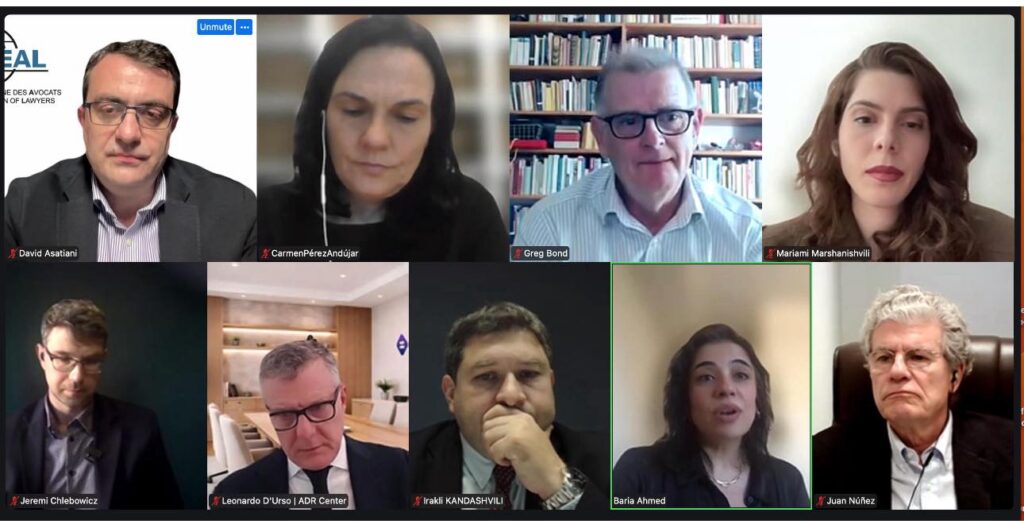
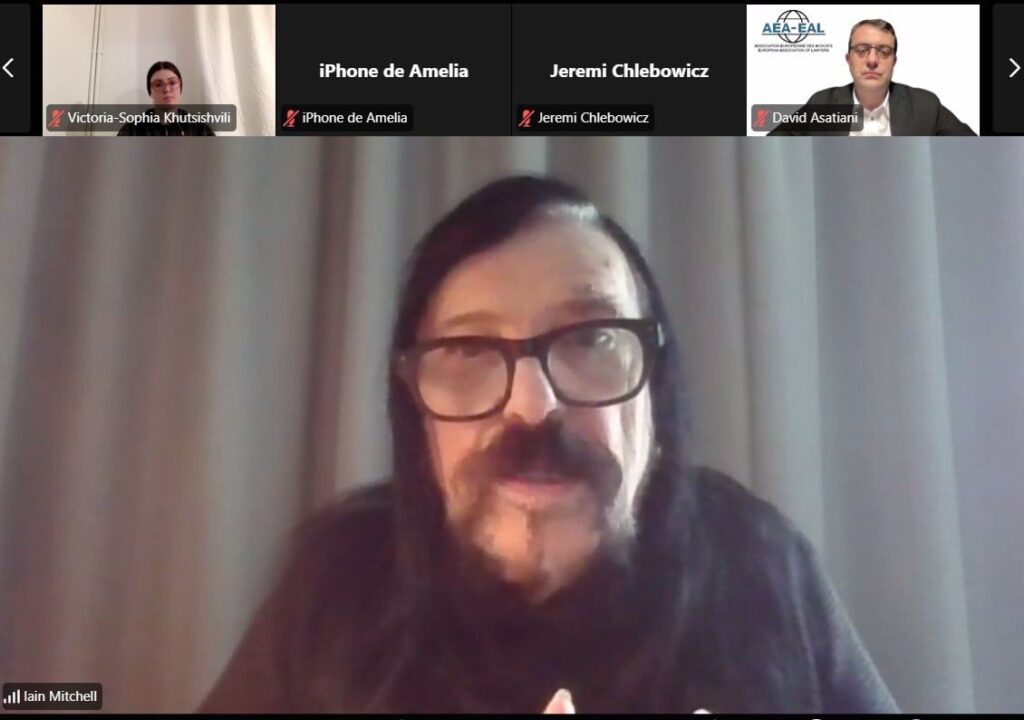
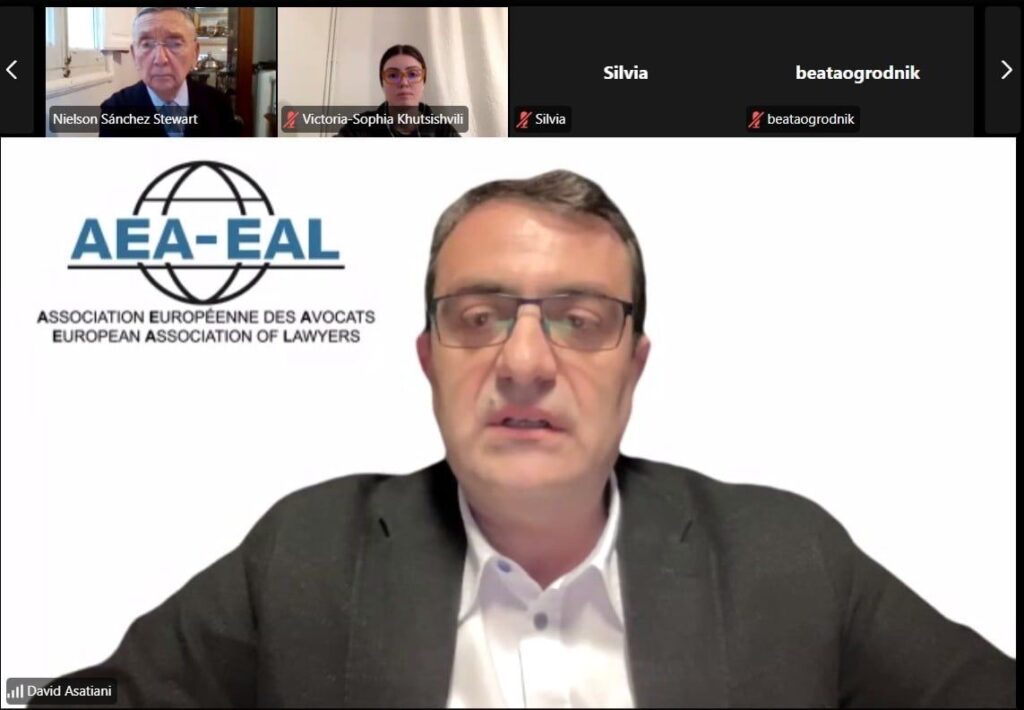
The AEA-EAL Deontology Committee successfully held its online webinar, Lawyers, Deontology and AI: Can those Match Together?, on 19 March 2026 via Zoom.

The session brought together distinguished legal professionals to explore the evolving relationship between legal ethics and artificial intelligence, addressing key questions of responsibility, liability, and ethical safeguards in modern legal practice. The discussion featured insightful contributions from leading experts and concluded with an engaging Q&A session.

The webinar was opened by Mr. David Asatiani, who welcomed participants and highlighted the importance of addressing the ethical implications of AI in the legal profession. The programme featured contributions from leading experts, including Mr. Nielson Sanchez-Stewart on the applicability of deontological principles to AI, Mr. Jean-Louis Collart on lawyers’ liability when using AI systems, Mr. Alex Tallon on ethical principles such as fairness and transparency, and Mr. Iain G. Mitchell KC on the risks and opportunities of AI in court submissions.

Special thanks are extended to Mr. Nielson Sanchez-Stewart for chairing the webinar and for his valuable leadership in advancing this important discussion.

The AEA-EAL expresses its sincere appreciation to all speakers and participants for their active engagement and contribution to the success of the event.


International Conference on Environmental Protection Supported by AEA-EAL was Held in Gdańsk, Poland

Articles, News, Past events

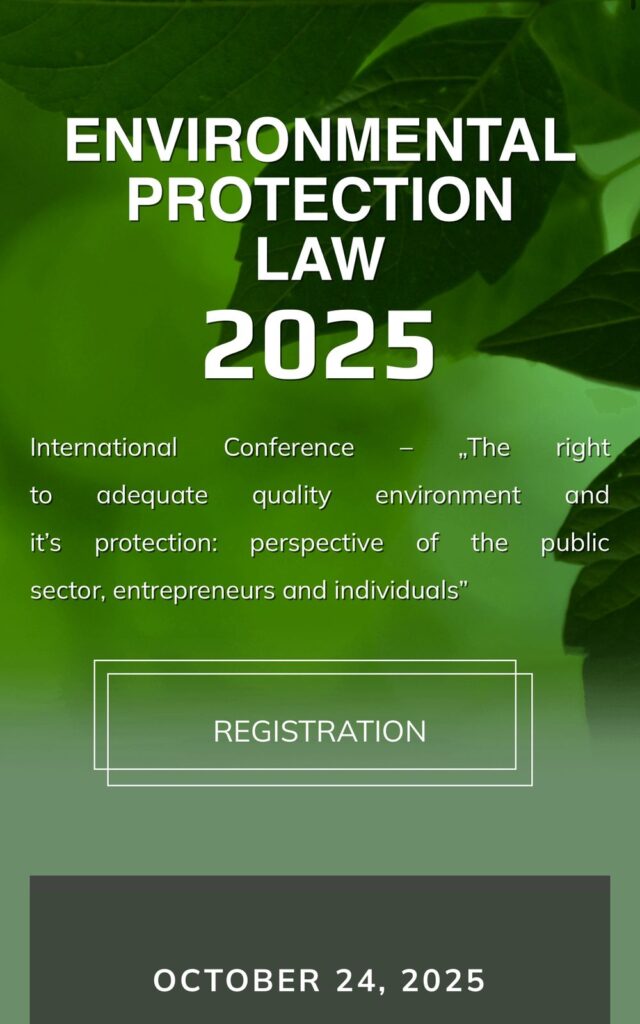
On October 24, 2025, the University of Gdańsk hosted the International Conference on “The Right to an Adequate Quality Environment and Its Protection: Perspectives of the Public Sector, Entrepreneurs and Individuals.”

The event was co-organized by the Gdańsk Bar Association of Attorneys-at-Law and the Faculty of Law and Administration at the University of Gdańsk, in collaboration with the European Association of Lawyers (AEA-EAL).

The conference brought together 20 distinguished speakers from around the world — including representatives from Indonesia, France, Belgium, and Georgia — spanning academia, legal practice, government, NGOs, and the business sector. Among the speakers were representatives of the Council of Europe, the European Court of Human Rights, and the European Association of Lawyers (AEA-EAL). AEA-EAL was represented by Immediate Past President Maria Ślązak, Chairman of the Sustainable Development Law Commission Giorgi Tshekhani, Attorney at Law Magdalena Witkowska, and Attorney at Law Patrick Van Cauwenberghe.

Beyond the formal sessions, participants enjoyed valuable opportunities for networking and exchange, exploring avenues for future cooperation. The conference underscored the crucial role of collaboration among academia, lawyers, NGOs, and governmental institutions in advancing environmental protection — a key challenge for the legal profession in the 21st century.

A New Member Has Been Elected to the Board of Directors of the European Association of Lawyers

Articles, News

On July 10, 2025, the Annual General Assembly of the European Association of Lawyers (AEA-EAL) was held, during which a new member of the Board of Directors was elected. Mr. Michał Widawski, Attorney at Law (Radca Prawny) and member of the Gdańsk Bar Association of Attorneys at Law (Poland), has joined the Board of AEA-EAL.

In professional career he holds a position of a Managing Partner at the Law Firm in Gdańsk and serves as general counsel in one of companies operating in CEE region. Beyond his primary responsibilities, he is involved in the corporate governance of other companies in Poland and actively collaborates with local and international organizations, NGOs, and academic institutions. His professional experience includes specialization in corporate law, M&A, due diligence, and the succession and restructuring of family-owned and international businesses. Michał directly works for international capital groups, and represents clients in civil, administrative, criminal, and commercial disputes.

Since 2012, Mr. Widawski has been serving as a member of the Permanent Commission for International Cooperation at the Gdańsk Bar Association of Attorneys at Law. Over the years, he has taken part as a speaker and delegate in numerous legal events across Europe and internationally. He also serves as a delegate in both regional and national elections to the Polish Bar Association of Attorneys at Law.

Mr. Widawski’s cooperation with the Association dates back to 2019, when he co-organized and participated as a speaker in the “Twinning of Lawyers” event held in Gdańsk, representing his Bar Association. He remains a strong advocate for the continuation of this initiative, launched by the immediate past President of AEA-EAL, Maria Ślązak.

His extensive experience and dedication to international legal cooperation will further strengthen the mission and activities of AEA-EAL.

Does Compliance end with a CCS?

Articles, News
Juan NunezThe Criminal Compliance System is increasingly adopted by Spanish companies to avoid the economic consequences of offences that may be committed within the companies by employees being extended to the members of the board of directors; this objective responsibility stems from a criminal conception according to which the company’s top management must have done everything possible to prevent offences from occurring, from which the company would obtain some benefit. This concept exists in a similar way in France with the Sapin II Law, and also in Germany, albeit in the administrative field. It should not be assumed, however, that elsewhere the consequences of negligent management or lack of control over the activities of employees are totally alien to the directors: the responsibility, in one way or another, falls, at the end of the day, on those who are ultimately responsible for an economic activity. This work goes even further, indicating that the work does not end with the adoption of the System, but it must be followed by its implementation.   The incorporation of Criminal Compliance System in companies is a practice that is becoming more widespread, both because of the consequences of not doing so and because of the extension of the ethical culture in business activity. On the one hand, the consequences focus on the fact that the directors (CEO) of a company must implement a control of the activity and its processes, so that if, due to the absence of this control, a person linked to the company were to commit an offence, the directors would be responsible for the financial damage caused. This result is based on the principle that those responsible for the company must do everything possible to prevent wrongdoing. On the other hand, the CCS, together with the codes of good governance and ethics that derive from them, sometimes oblige companies to relate only with companies that have implemented their own, so that not having them in place will lead, to an increasing extent, to lost business opportunities. It has to be kept in mind, and has been often emphasised, that the CCS in itself is not sufficient.  Some Supreme Court rulings have been very clear in determining that the CCS cannot be a simple copied protocol, poorly adapted; it cannot be a cover to avoid the application of Art. 31 and 129 of the Spanish Criminal Code, but must be consciously implemented so that it fulfils its regulatory and controlling function in those cases in which it could be used to commit offences. Rule 1/2016 of the State Attorney General’s Office has been particularly explicit in relation to the implementation in organisations of merely „aesthetic” crime compliance systems, leaving aside the true spirit that CCSs must contain, and which therefore would not serve their intended purpose. Therefore, a Criminal Compliance System shall be configured as an absolutely individualised service designed for the specific characteristics of each company, and its development as well. Many companies and entrepreneurs, however, only understand Compliance as an imposed necessity and not as an advantage. Consequently, with this concept of necessity, they often stick to the CCS, considering that a facelift will be enough to keep them in the club of excellence. On the contrary, companies should understand that, in addition to being a legal obligation under art. 31 bis Spanish Penal Code, implementing these plans is what the Anglo-Saxons call a ‘business benefit’. However, in order to obtain this result, it is necessary to develop the CCS so that it can truly unfold its effects: the CCS is a declaration of intent; a desideratum of conduct and controls that shall be duly disseminated among all the components of the company. But, what then? Can it be considered sufficient to indicate what shall not be done, or shall controls really be put in place to detect and prevent contraventions of these indications? We understand that all means must be put in place to prevent the omission of wrongdoing, which requires more than a CCS: its development. In order to develop the CCS, it is necessary to analyse the aspects to be controlled and to implement these controls, to determine the information routes, to appoint the controllers. To this end, specific protocols and policies are implemented, such as, for example, those regulating conflicts of interest, the preservation of business secrets, the use of digital certificates, the selection of suppliers, the circulation of information and documentation, the prevention of money laundering, tax policy, sales policy, digital disconnection policy, … all those that may be considered necessary to successfully implement a CCS and for it to be a real and effective tool. It is obvious that a company correctly equipped with these instruments will not only be more appreciated in its daily operations and in the eyes of its suppliers and customers (the business benefit), but will also be much more highly valued by potential investors. Juan Núñez – Bdabogados.com